 By Evina Georgiou (TR02) and Margarita Giannoutsou MAT (HAEC) Students
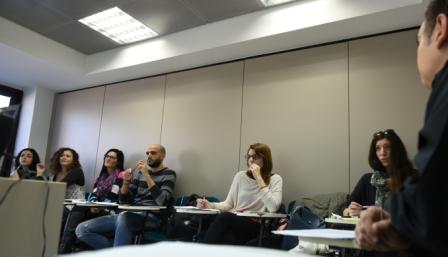
During a one-hour interview, students in the Master of Arts in Translation (MAT) program at Hellenic American University had the chance to prepare for their own future job interviews in a rather unconventional way by reversing roles and preparing a set of in-depth questions on:
- translation practices in an international industrial context
- current market developments and
- career opportunities and requirements.
Students discussed these issues with Georgios Kapsokalyvas, CEO and founder of Glossa Group, a multinational translation agency based in Hamburg. Here's their story.
Glossa Group
We were first interested in getting to know more about the company itself, so we asked about its services and technological innovations. Mr. Kapsokalyvas explained that for a translation agency to successfully meet global competition in a growing market with many players, it needs to specialize in various fields of expertise and cater to many language combinations, including numerous Asian and Indian dialects. "In addition to such language and localization services, knowledge ability in language technologies has also become increasingly important," he stressed.
Technology
In this context, he urged us to familiarize ourselves with the use of Computer-Assisted Translation software and other technologies since they have become essential elements of a translator's work in today's world. Mr. Kapsokalyvas stated that "without technological innovation, a translation company cannot survive these days. Technology has become the center of the world and translation is right in the middle of it."
That said, he calmed our concerns that human translation will eventually be replaced by Machine Translation, explaining that "Machine Translation has been around for almost 50 years now and it is true that over the last 10 years it has made huge leaps forward. However, Machine Translation mostly pays for extremely standardized and short-lived texts, such as weather reports. In a number of cases it may indeed offer low-cost pre-translations for post-editing, but since the market is growing and high-quality texts are in demand, this technology will never be able to replace human translation."
Career prospects and strategies
A final round of questions was dedicated to career prospects and strategies in the translation industry as well as to employment and payment modalities for both in-house and freelance translators.
Mr. Kapsokalyvas provided us with specific information on wages and rates and advised us to look for 3-6 month internships in translation agencies or in the language departments of big industrial European companies after graduation in order to gain practical knowledge, work experience and additional CV credentials. He also stressed that young professionals need to be aware of related employment opportunities in the industry, such as terminology management, project management or quality control.
Finally, we Asked Mr. Kapsokalyvas about starting one's own translation company. He noted that doing so requires total devotion to the business, emphasizing that the hardest part is customer acquisition. Regarding the establishment of a company in Greece, he stated that even though the Greek market is currently in a state of flux it could still be worthwhile given that the high level of IT expertise in Greece, the growth in translation business and EU export regulations that require local product translations.
The interview, organized as part of the course on "Professional Trends in Translation" and conducted via Skype, proved to be a beneficial experience for all participants:
- We as students, all keen language learners and in many cases already experienced language professionals in the field of teaching (but as yet still "fresh" in the business of translation) had the chance to articulate our concerns and get authoritative advice on future career paths.
- Our instructor, Dr. Margarita Giannoutsou, Head of Customer Relations at Glossa Group, who facilitated and co-attended the session, gained a deeper understanding of our needs for applied science that might feed into future in-class training projects.
- And, last but not least, Mr. Kapsokalyvas, a German entrepreneur of Greek origin, being the interviewee for once, was made aware of the high level of motivation and interpersonal skills which the next generation of young Greek language professionals is bringing into the market.
Image: HAEC MAT Student Evina Georgiou.


